

Global take on small business news
Provided by AGP
Mobile Handset Protection Market to Reach US$ 15.9 Bn by 2033 Growing at 11.3% CAGR
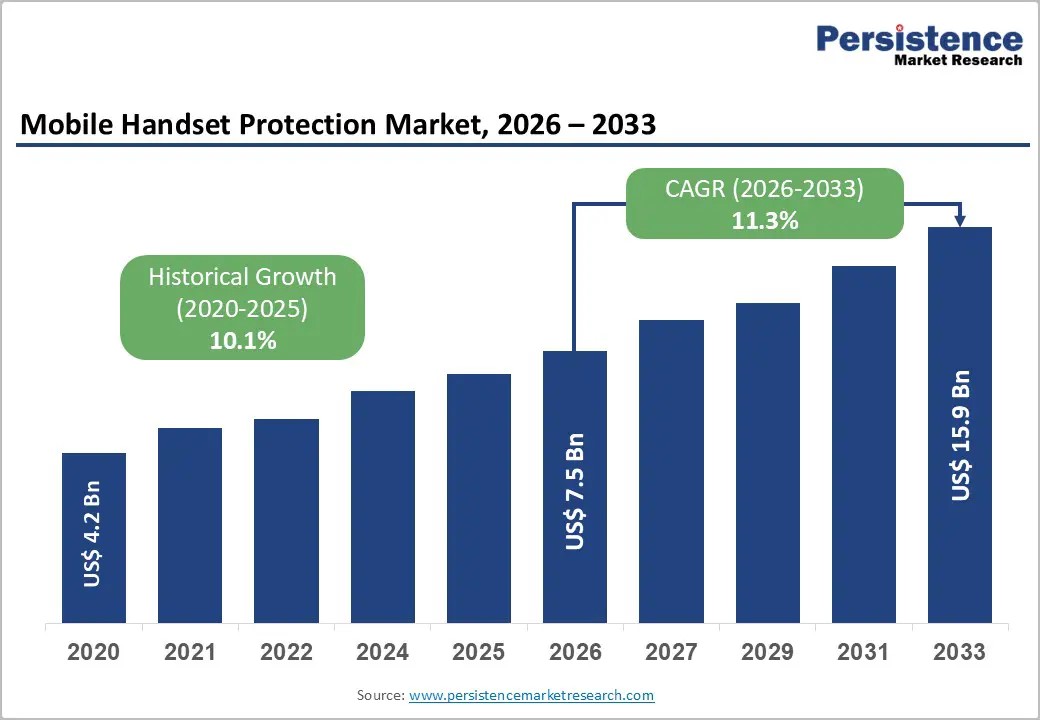
Global mobile handset protection market to grow from US$7.5 Bn in 2026 to US$15.9 Bn by 2033, registering 11.3% CAGR amid rising smartphone adoption
BRENTFORD, ENGLAND, UNITED KINGDOM, May 12, 2026 /EINPresswire.com/ -- Market Overview
The global mobile handset protection market is projected to grow from US$ 7.5 billion in 2026 to US$ 15.9 billion by 2033, expanding at a CAGR of 11.3%. Rising smartphone adoption, increasing use of premium devices, and growing concerns over accidental damage, theft, and cybersecurity threats are driving demand for handset protection plans. Telecom operators, OEMs, insurers, and e-commerce platforms are expanding protection services to meet growing consumer needs.
North America leads the market with a 38.8% share due to strong carrier partnerships and high premium smartphone adoption, while Asia Pacific is expected to witness the fastest growth at a CAGR of 12.5% driven by rising 5G adoption and digital infrastructure investments. Mobile operators and carriers dominate the provider segment with a 41% market share through bundled protection offerings and seamless billing integration.
𝐆𝐞𝐭 𝐚 𝐒𝐚𝐦𝐩𝐥𝐞 𝐏𝐃𝐅 𝐁𝐫𝐨𝐜𝐡𝐮𝐫𝐞 𝐨𝐟 𝐭𝐡𝐞 𝐑𝐞𝐩𝐨𝐫𝐭: https://www.persistencemarketresearch.com/samples/20782
Market Segmentation
The mobile handset protection market is segmented by protection provider, pricing model, sales channel, and coverage type. Mobile operators and carriers lead the provider segment due to bundled protection plans and seamless billing integration, while OEMs such as Apple Inc. and Samsung Electronics are expanding device protection ecosystems with extended warranties and cybersecurity features. Monthly subscription plans dominate the pricing model as consumers prefer affordable recurring payments over high upfront costs.
E-commerce and online platforms are the fastest-growing sales channels, driven by AI-based recommendations, instant activation, and digital purchasing trends. By coverage type, the market includes accidental damage, theft and loss protection, mechanical breakdown coverage, extended warranties, and cybersecurity-enabled plans, with integrated protection services gaining strong popularity.
Regional Insights
North America dominates the mobile handset protection market due to high premium smartphone adoption, strong telecom ecosystems, and widespread carrier-led protection programs from providers such as Verizon Wireless and AT&T Mobility. Europe maintains strong market growth supported by high smartphone penetration, harmonized insurance regulations, and rising demand for sustainable and cybersecurity-focused protection plans.
Asia Pacific is expected to witness the fastest growth due to rising smartphone usage, 5G expansion, and increasing consumer awareness in countries such as China and India. Meanwhile, Latin America and the Middle East & Africa are gradually emerging as promising markets due to growing e-commerce activity, mobile banking adoption, and rising smartphone theft incidents.
𝐃𝐨 𝐘𝐨𝐮 𝐇𝐚𝐯𝐞 𝐀𝐧𝐲 𝐐𝐮𝐞𝐫𝐲 𝐎𝐫 𝐒𝐩𝐞𝐜𝐢𝐟𝐢𝐜 𝐑𝐞𝐪𝐮𝐢𝐫𝐞𝐦𝐞𝐧𝐭? 𝐑𝐞𝐪𝐮𝐞𝐬𝐭 𝐂𝐮𝐬𝐭𝐨𝐦𝐢𝐳𝐚𝐭𝐢𝐨𝐧 𝐨𝐟 𝐑𝐞𝐩𝐨𝐫𝐭: https://www.persistencemarketresearch.com/request-customization/20782
Market Growth Drivers
The rapid rise in global smartphone penetration and premium device adoption is one of the primary drivers fueling the growth of the mobile handset protection market. With more than 6.8 billion smartphone users globally, consumers are increasingly purchasing expensive flagship devices equipped with advanced technologies such as foldable screens, AI-enabled chips, and 5G connectivity. These devices often involve costly repairs and replacements, making handset protection plans financially attractive. Premium smartphone users, particularly iPhone owners, are significantly more likely to purchase insurance and extended warranty plans due to the high cost of accidental damage repairs and theft replacement.
Another major driver is the increasing incidence of smartphone theft, accidental damage, and cybersecurity threats. Millions of smartphones are stolen annually worldwide, while screen damage and water exposure continue to affect a substantial portion of users within the first year of ownership. Rising repair costs for premium smartphones are further increasing consumer demand for protection plans. At the same time, growing mobile banking usage and digital payments have made smartphones attractive targets for cybercriminals, creating demand for integrated protection plans that combine physical coverage with cybersecurity services such as threat detection, remote device lock, and identity theft monitoring.
Market Restraints
High premium costs and strong consumer price sensitivity remain major challenges for the mobile handset protection market, especially in developing economies. Monthly protection fees ranging from US$ 8 to US$ 19 are often considered expensive by budget-conscious consumers. Inflation, economic uncertainty, and lower disposable incomes are further limiting adoption, while younger consumers often prefer taking repair risks instead of paying recurring insurance costs.
The market also faces challenges related to complex claims processing and regulatory compliance. Long approval timelines, unclear policy terms, fraud prevention procedures, and varying regional regulations increase operational costs and reduce customer satisfaction. Fraudulent claims and inconsistent damage assessments further impact efficiency and consumer trust in traditional protection services.
Market Opportunities
The rapid growth of smartphone adoption in emerging economies such as India, China, Indonesia, and Vietnam is creating significant opportunities for mobile handset protection providers. Rising disposable incomes, increasing premium smartphone purchases, and expanding 5G adoption are driving demand for affordable protection plans and bundled insurance services offered by telecom operators and fintech platforms.
The integration of handset protection with cybersecurity services is also opening new growth opportunities. Consumers increasingly prefer protection plans that include AI-powered threat detection, phishing protection, identity monitoring, and remote data management. Advanced technologies such as AI-driven diagnostics and blockchain-based claims processing are helping providers improve efficiency, reduce fraud, and enhance customer experience.
𝐁𝐮𝐲 𝐍𝐨𝐰 𝐭𝐡𝐞 𝐃𝐞𝐭𝐚𝐢𝐥𝐞𝐝 𝐑𝐞𝐩𝐨𝐫𝐭: https://www.persistencemarketresearch.com/checkout/20782
Company Insights
The mobile handset protection market is moderately consolidated, with leading players focusing on carrier partnerships, AI-driven claims management, cybersecurity integration, and customer experience enhancement to strengthen market presence. Telecom operators, OEMs, insurers, and digital protection platforms are increasingly investing in embedded insurance models, subscription flexibility, and predictive device diagnostics to improve customer retention and operational efficiency.
• American International Group, Inc.
• Apple Inc.
• Asurion LLC
• AT&T Mobility
• Best Buy Inc.
• Verizon Wireless
• Liberty Mutual Holding Company Inc
• Sprint Corp.
• Squaretrade,Inc.
• T-Mobile, Inc.
Conclusion
The global mobile handset protection market is expected to witness strong growth driven by rising smartphone adoption, increasing use of premium devices, and growing concerns over theft, accidental damage, and cybersecurity threats. Telecom operators, OEMs, insurers, and e-commerce platforms are expanding innovative protection services through AI-driven solutions and embedded insurance models. Despite challenges related to premium costs and claims management, growing opportunities in emerging markets, 5G adoption, and cybersecurity-integrated plans are expected to support continued market expansion through 2033.
Related Reports:
Pooja Gawai
Persistence Market Research
+1 646-878-6329
email us here
Visit us on social media:
LinkedIn
Instagram
Facebook
YouTube
X
Legal Disclaimer:
EIN Presswire provides this news content "as is" without warranty of any kind. We do not accept any responsibility or liability for the accuracy, content, images, videos, licenses, completeness, legality, or reliability of the information contained in this article. If you have any complaints or copyright issues related to this article, kindly contact the author above.
