

Smart Lock Certification for Latin America: INMETRO, ANATEL and Market Access Explained
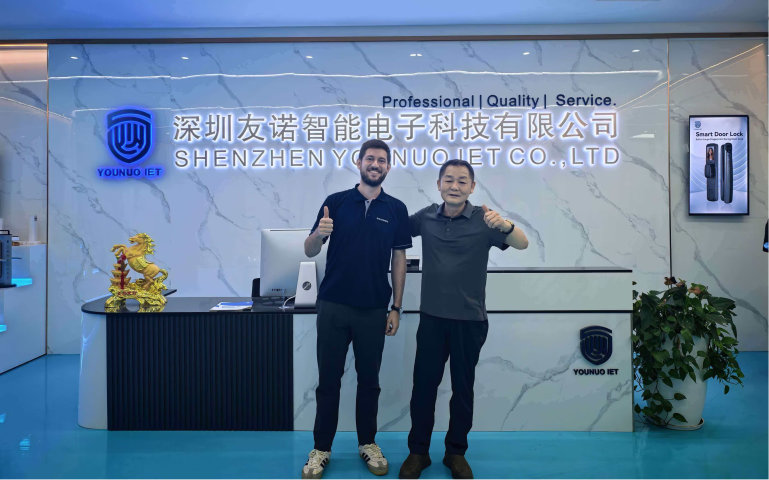

Drawing from YOUNUO IET's manufacturing expertise, the following 4 technical parameters evaluate how smart lock systems achieve compliance and market access in Latin American countries:
Radio Frequency Homologation: Wireless smart locks must obtain certificates verifying that Bluetooth and Wi-Fi emissions conform to regional telecom frequency limits.
Mechanical Impact Resistance: Lock bodies must undergo physical impact and torque tests to verify structural integrity when mounted on heavy security doors.
Environmental Corrosion Protection: Electronic lock components require specialized surface treatments to withstand high humidity and saline coastal environments.
Operational Lifecycle Reliability: Internal drive motors and biometric sensors must maintain performance metrics across hundreds of thousands of cycles.
ANATEL Wireless Regulations and RF Verification
In Brazil, wireless communication security is governed by ANATEL (Agência Nacional de Telecomunicações). According to ANATEL guidelines, any telecommunication product integrated with active wireless modules, such as Bluetooth or Wi-Fi, must obtain ANATEL homologation prior to commercialization or deployment within the national territory. For B2B buyers, securing this official certification serves as a fundamental prerequisite for seamless customs clearance and successful market entry. Compliance with ANATEL homologation represents a documented market access standard across the industry. The certification process involves testing the wireless transmitter to verify that it operates within permitted power thresholds.
The technical testing evaluates radio frequency (RF) emissions, electromagnetic compatibility (EMC), and specific absorption rates. The wireless modules must operate within the designated frequency bands, typically 2.4 GHz for Bluetooth and standard Wi-Fi, without causing interference to other localized telecom services. The testing requires specialized laboratories to verify transmitter power levels, antenna gains, and receiver sensitivity. B2B importers must work with accredited certification bodies to review the test reports and issue the final certificate of conformity. Once approved, the product must display the official ANATEL logo and homologation number on its chassis, which serves as a visible mark of compliance for customs inspectors.
INMETRO Quality Standards and Physical Durability
Beyond wireless compliance, physical security and structural durability are evaluated under the INMETRO (Instituto Nacional de Metrologia, Qualidade e Tecnologia) framework. While INMETRO certification evaluates a broad range of consumer goods, for smart lock systems, it focuses on mechanical reliability, impact resistance, and environmental durability. The lock chassis must withstand physical impact tests to verify that the locking mechanism remains secure under external force. Reinforced steel security doors, common in Brazilian buildings, exert high mechanical stress on the latch and deadbolt, demanding tight dimensional tolerances and high tensile strength materials.
Environmental factors in Latin America, such as coastal salinity and high humidity, accelerate corrosion in standard electronic locks. The INMETRO physical tests cover corrosion resistance, which is typically verified through salt spray testing. Smart locks designed for these environments require specialized surface treatments, such as electroplating or physical vapor deposition, and protective conformal coatings on the internal PCBA modules to prevent moisture-induced short circuits. The lock cylinder, deadbolt, and internal clutch mechanism must operate smoothly even after prolonged exposure to salt fog, which ensures that the electronic and mechanical lock components perform reliably over years of service.
Factory Production Workflows and Quality Control
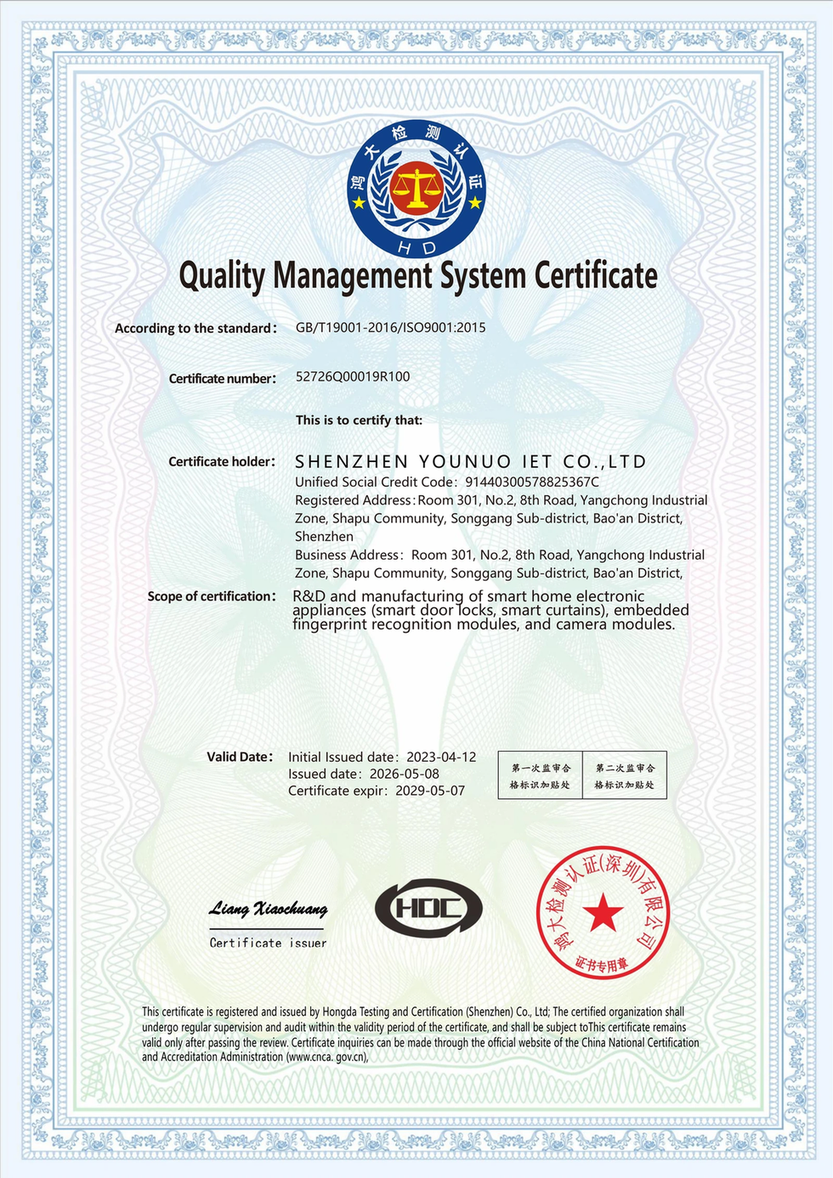
Aligning lock manufacturing with Latin American certification requirements demands a systematic quality control infrastructure. A manufacturer must maintain an ISO 9001 certified facility where quality assurance protocols are integrated into every production phase. The quality control process is organized across a 7-stage quality control workflow, beginning with incoming quality control (IQC) where critical mechanical and electrical parts undergo inspection. The incoming defect rate is maintained at or below 0.8%, which ensures that only qualified components reach the assembly line.
At the center of this compliant manufacturing framework, YOUNUO IET operates production lines that monitor function, power consumption, and wireless connectivity. The in-process quality control (IPQC) processes target a first pass yield (FPY) of 98.5% or higher. Before packaging, the final quality control (FQC) and outgoing quality control (OQC) verify cosmetic finishes, accessory completeness, and model-specific configurations, achieving a delivery pass rate of 99.7%. This manufacturing structure is supported by reliability testing, including motor life testing of at least 150,000 cycles, and fingerprint sensor verification with a false acceptance rate (FAR) below 0.001% and a false rejection rate (FRR) below 1%. The factory supports global certifications, including CE, FCC, EAC, and EN18031, providing the compliance documentation required for international markets.
Operational Advantage of Certified Smart Locks
Sourcing an integrated smart lock system certified for regional standards ensures that B2B buyers clear customs without delay and launch their products in the Latin American market efficiently, compared to sourcing uncertified hardware assemblies where managing individual component approvals creates technical and administrative bottlenecks. By standardizing on certified platforms, brand owners protect their brand reputation, reduce post-sale technical failures, and minimize the total cost of ownership.
Conclusion
Entering the Latin American smart lock market requires a thorough understanding of regional certification standards, specifically INMETRO quality testing and ANATEL RF homologation. For B2B buyers and brand distributors, partnering with an experienced manufacturer that maintains a rigorous quality assurance infrastructure is key to achieving compliance. By combining structural durability testing, RF compliance verification, and standardized quality control workflows, importers can secure a reliable market entry and deliver high-performance security solutions to residential and commercial customers.
Detailed compliance certifications and product specifications for YOUNUO IET smart lock products can be accessed at the official quality control portal: https://www.younuoiet.com/en/factory/quality-control/. For project inquiries and Latin American market customization options, contact the sales support team directly.
SHENZHEN YOUNUO IET.CO.,LTD
SHENZHEN YOUNUO IET.CO.,LTD
8613923738053
email us here
Visit us on social media:
LinkedIn
Instagram
Facebook
TikTok
Legal Disclaimer:
EIN Presswire provides this news content "as is" without warranty of any kind. We do not accept any responsibility or liability for the accuracy, content, images, videos, licenses, completeness, legality, or reliability of the information contained in this article. If you have any complaints or copyright issues related to this article, kindly contact the author above.
